

In the thrilling sport of paragliding, clouds can be both a boon and a bane. On one hand, they serve as valuable indicators of thermal activity, helping pilots gain altitude and extend their flights. On the other hand, clouds can present significant dangers, such as reduced visibility, turbulence, and the perilous phenomenon known as cloud suck. Understanding how to navigate and interpret different cloud types is crucial for safe and enjoyable paragliding. While cumulus clouds often signal favorable flying conditions, pilots must exercise caution and avoid cumulonimbus clouds, which are associated with severe weather and high-risk flying conditions. This article explores the dual nature of clouds in paragliding and provides insights into which cloud formations to seek out and which to steer clear of.
Benefits of Clouds in Paragliding

1. Indicating Thermal Activity
Thermal Indicators:
Clouds, particularly cumulus clouds, often indicate the presence of thermals—rising columns of warm air generated by uneven heating of the Earth’s surface. These thermals are essential for paraglider pilots as they provide the lift needed to gain altitude and sustain longer flights. By identifying cumulus clouds, pilots can locate and exploit these thermals, allowing them to ascend and stay airborne for extended periods.
Efficient Navigation:
Experienced pilots utilize clouds as navigational tools to locate thermals more efficiently. By observing the base of cumulus clouds, pilots can determine where thermals are likely to be strongest. This practice not only enhances flight efficiency but also adds an element of strategy, as pilots can plan their routes based on the anticipated location of thermals, leading to more enjoyable and rewarding flights.
2. Enhancing Lift
Improved Lift:
Certain cloud formations, such as cumulus clouds, enhance lift by indicating areas where rising air currents are present. These clouds form as a result of thermals reaching higher altitudes and condensing moisture into visible cloud formations. Flying under these clouds can provide consistent lift, allowing pilots to maintain or gain altitude with less effort.
Energy Conservation:
By utilizing the lift provided by thermals associated with clouds, pilots can conserve energy and reduce the need for frequent altitude adjustments. This energy conservation is crucial, especially during long flights, as it enables pilots to focus on navigation and enjoying the experience rather than constantly seeking out lift sources. Efficient use of thermals also extends flight duration and distance, making the overall paragliding experience more satisfying.
3. Visual Landmarks
Navigational Aids:
Clouds serve as natural visual landmarks that assist pilots in orienting themselves and navigating across the landscape. In the absence of other prominent geographical features, clouds can provide reference points that help pilots maintain their course and avoid getting disoriented.
Route Planning:
Pilots can use cloud formations to strategically plan their routes during flights. By identifying patterns in cloud cover and understanding the weather dynamics, pilots can anticipate areas with better lift conditions and avoid regions with potential hazards. This strategic route planning ensures a smoother and more predictable flight experience, enhancing both safety and enjoyment.
Dangers of Clouds in Paragliding
1. Reduced Visibility
Loss of Visual Reference:
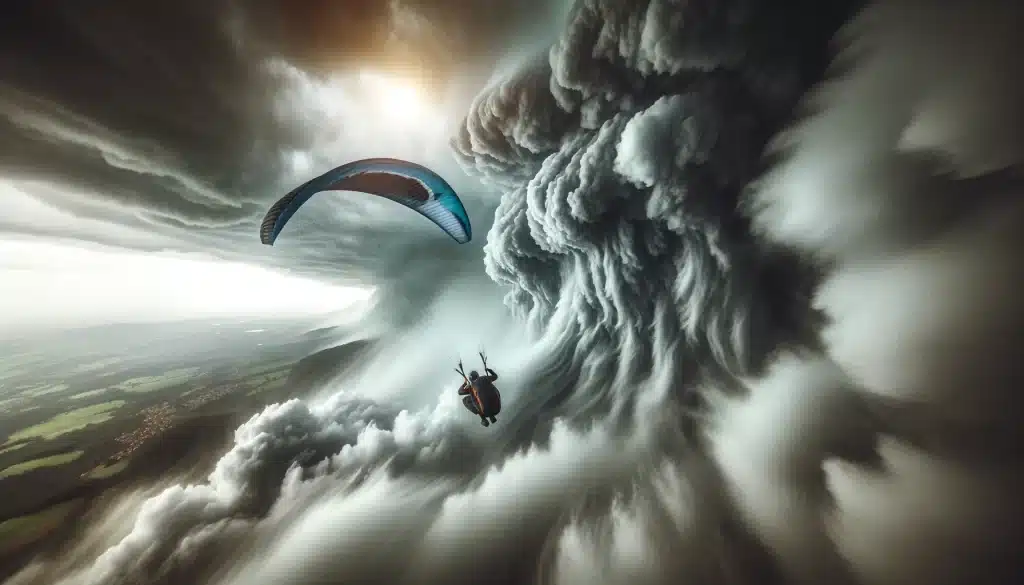
Flying into or near clouds can result in a sudden loss of visual reference, making it extremely difficult for pilots to maintain orientation and control of their paraglider. This is particularly dangerous in dense cloud cover, where a pilot can quickly become enveloped, losing sight of the ground, the horizon, and other visual cues necessary for stable flight.
Disorientation:
Reduced visibility can lead to spatial disorientation, a condition where a pilot is unable to accurately perceive their position, motion, and altitude relative to the Earth. This disorientation can cause pilots to make incorrect control inputs, increasing the risk of accidents. Spatial disorientation is particularly hazardous because it can happen suddenly and without warning, leaving pilots little time to react.
2. Cloud Suck
Rapid Altitude Gain:
Cloud suck is a phenomenon where a paraglider is rapidly drawn into a cloud due to strong upward currents. This can cause an uncontrolled and dangerous altitude gain. The intense upward lift can overwhelm a pilot’s ability to descend or navigate out of the lift, potentially leading to severe disorientation and loss of control.
Hypoxia Risk:
As a paraglider ascends rapidly into higher altitudes, the risk of hypoxia (a condition where the body is deprived of adequate oxygen) increases. Hypoxia can impair a pilot’s cognitive and motor functions, leading to dizziness, confusion, and even loss of consciousness. This poses serious health risks and can result in life-threatening situations if not managed promptly.
3. Turbulence and Wind Shear
Turbulent Conditions:
Clouds, especially cumulonimbus clouds, are often associated with turbulent air and strong wind shear. Turbulence can create unpredictable and violent air movements that destabilize the glider, making it difficult for pilots to maintain steady flight. Turbulence is particularly dangerous when it occurs unexpectedly or in severe weather conditions.
Pilot Control:
Turbulence and wind shear can significantly challenge a pilot’s ability to maintain control and stability of the paraglider. Sudden changes in wind speed and direction can cause the glider to pitch, roll, or yaw abruptly, requiring quick and precise corrective actions from the pilot. In extreme cases, turbulence can lead to partial or full collapses of the glider, necessitating advanced recovery techniques.
4. Electrical Storms
Lightning Hazard:
Flying near cumulonimbus clouds increases the risk of encountering electrical storms and lightning. Lightning poses a direct threat to the safety of the pilot and the integrity of the glider. A lightning strike can cause serious injury or death and can also damage the glider, making it unfit for further flight.
Severe Weather:
Clouds associated with thunderstorms can bring severe weather conditions, including heavy rain, hail, and strong winds. These conditions can drastically reduce visibility, increase turbulence, and make navigation extremely difficult. Severe weather can also lead to sudden and dangerous changes in flight conditions, posing significant risks to the pilot’s safety.
Conclusion